BRAND AUTOPSY · 02
Burberry: Every Rebrand
Announced as a Return to Essence
Léa Mondoloni · April 2026 · 5 min read ↓
THE OBSERVATION
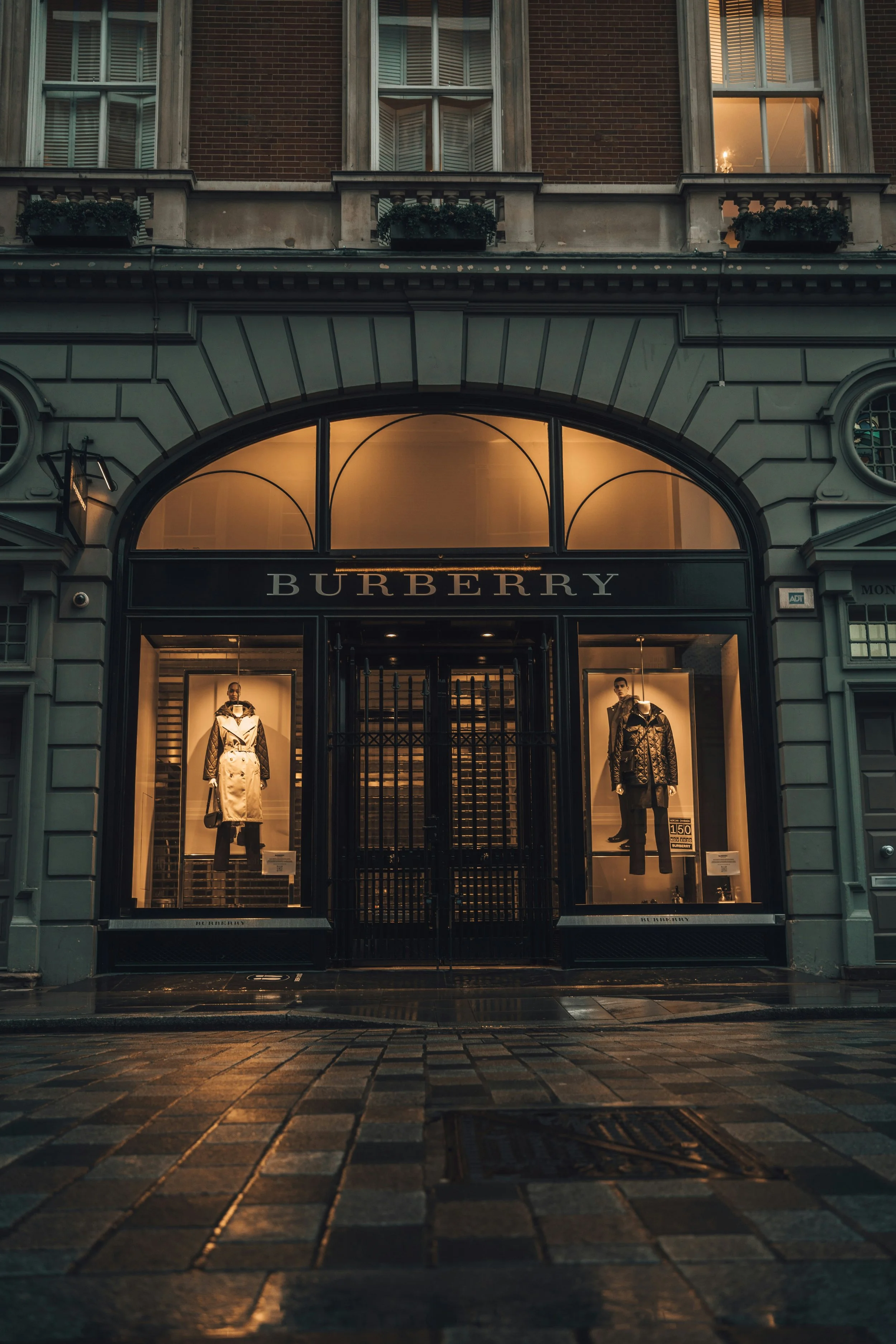
Burberry has had four creative directors in twelve years. Each arrival has been staged as a correction a return to what the brand really is, a clarification of what it was always supposed to mean. Each departure has been explained as a necessary evolution, a pivot toward the next chapter. And each succession has been accompanied by the same implicit premise: that the previous iteration was a wrong turn, and that this time, finally, we have found the right direction.
Christopher Bailey spent thirteen years building an empire on digital fluency and British romanticism. Riccardo Tisci arrived in 2018 promising urban edge and an expanded cultural conversation. Daniel Lee joined in 2022 with a mandate for quiet, assertive luxury — less noise, more conviction. The campaigns under Lee are technically accomplished. The visual language is coherent. The craft is evident.
And yet. Ask a luxury consumer, any luxury consumer, anywhere — what Burberry stands for beyond the trench coat and the check, and watch the pause before the answer. Not uncertainty about the current collection. Uncertainty about the brand itself. What it believes. What it would never compromise. What it would look like if you stripped every visual reference and asked what remained.
The pause is the problem. It is not a creative pause. It is an existential one.
THE DIAGNOSIS
What Burberry has confused, across four creative directorships, is the difference between consistency and character. Consistency is a visual language held across seasons — the same palette, the same proportions, the same compositional grammar. Character is something different and something harder. Character is what a brand believes when no one is asking, what it would refuse to do even if the business case made sense, what accumulates in the mind of its audience not as a logo recognition but as a felt sense of knowing exactly who this is.
Hermès has character. It is not expressed primarily through visual language. It is expressed through a set of convictions, about craftsmanship, about time, about the relationship between luxury and restraint that survive every creative change because they are structural, not aesthetic. You can alter every visual element of Hermès and the character persists. It has been built into the brand's operating logic, not into its campaigns.
Burberry has built, across its recent history, a succession of aesthetics. Each one is coherent. None of them is Burberry in the way that a Birkin is Hermès or a black sweater is The Row. The brand keeps designing new visual systems and calling them brand identity. But visual systems are not identity. They are the expression of identity. And the thing being expressed — the core conviction, the irreducible belief, the thing Burberry would stand for even if fashion moved in a different direction — has never been clearly articulated by the brand itself, let alone felt by its audience.
The result is a luxury house that is perpetually legible and never truly recognisable. You can identify a Burberry campaign immediately. You cannot feel it in the way that certain encounters with Chanel or Dior or Margiela create something closer to recognition — the experience of a brand knowing something true about the world and saying it.
THE IMPLICATION
Burberry's challenge is not its next creative director. It is its next answer to a different question: what does this brand believe that no other luxury brand believes? Not what does it look like — what does it stand for? The trench coat is not an answer to that question. It is a product. Heritage is not an answer either. Heritage is a starting point, not a conviction.
The most durable luxury brands are not the ones with the most interesting aesthetics. They are the ones whose audiences have internalised a clear sense of the brand's values to the point where they could articulate it unprompted, in their own words, without referencing a logo or a product. That is the test Burberry has not yet passed, and passing it requires something that no creative director alone can provide: a strategic decision, made at board level, about what this brand believes and what it will sacrifice to keep believing it.
Until that decision is made, every creative direction will be, at best, a beautiful holding pattern. And beautiful holding patterns are exactly what the luxury market has more of than it knows what to do with.
“Every rebrand has been announced as a return to essence. None has yet defined what that essence actually is.”
— Léa Mondoloni, Paris · 2026